

Client: LMC Casey Enterprises (LMC Casey)
Industry: Construction-materials brokerage
Engagement: Supply Chain and Revenue Operations advisory; solution-market navigation
Status: Vendor sourcing and selection complete. Implementation in progress.
Executive Summary
LMC Casey faced a revenue-operations control problem disguised as an invoicing-software search. Following a computer crash, a two-person construction-materials brokerage with reported annual revenue above $2 million needed to restore invoice continuity, preserve customer-specific billing practices, protect its overhead-and-profit (O&P) economics, and create a workable record base for bookkeeping and year-end tax preparation.
Kaiban reframed the challenge from “find an invoice tool” to “design a minimum viable order-to-cash operating model.” It translated LMC Casey’s field-level requirements into a decision framework across revenue protection, procurement traceability, usability, configurability, reporting, security/accountability, implementation burden, and affordability. That work identified CommonThread as the preferred solution because it demonstrated an ability to centralize customer, vendor, project, PO, invoice, document, PDF, and reporting workflows while allowing a deliberately phased implementation. The recommended starting point was a $5,000 five-week Quick Focus, rather than the broader $35,000 continuity sprint that LMC Casey declined due to liquidity constraints.
The Business Problem
Operating Context
LMC Casey operates as a lean construction-materials brokerage serving customers in Massachusetts and Rhode Island. The business reported more than $2 million in annual revenue with two employees. Its operating model depends on timely pass-through invoicing, client-specific document requirements, vendor/source information, purchase orders, project tracking, taxes, and the recovery of O&P or administrative economics.
A computer crash exposed the fragility of this model. LMC Casey reported that a $90,000 invoice received on the second of a month was not sent until the twenty-sixth. It also reported that lost or inaccessible invoices, purchase orders, contracts, and spreadsheets could put material revenue and customer relationships at risk. The immediate requirement was not an enterprise ERP: it was a reliable, right-sized way to issue invoices, retrieve supporting documents, see what was open, and preserve the rules that determine what LMC Casey earns.
Requirements Kaiban Surfaced
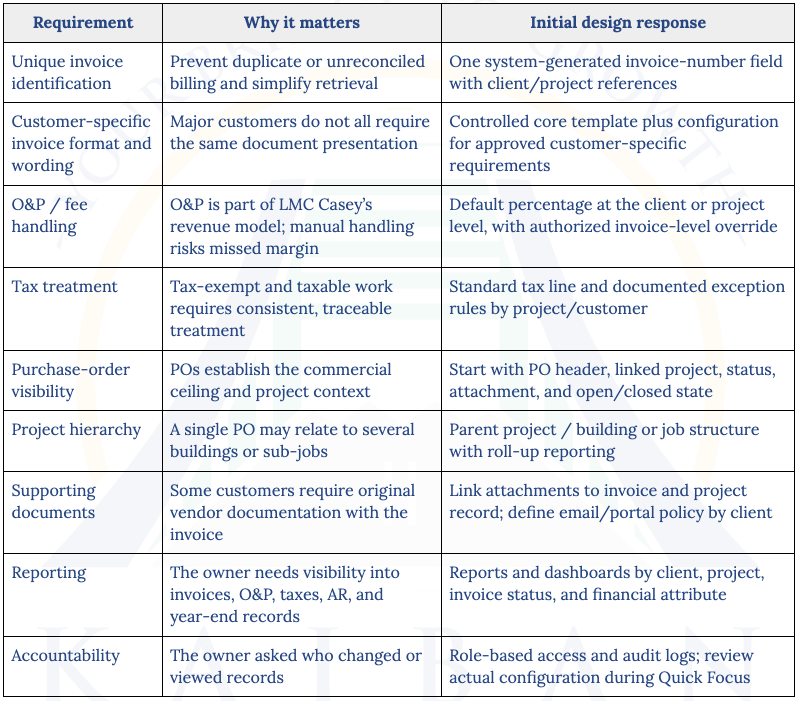
Kaiban’s Supply Chain and RevOps Role
Kaiban did not position a generic platform as the answer. It performed the work of an operating-model translator and buyer-side advisor:
Diagnose the workflow. Kaiban documented the lifecycle from client purchase order to supplier sourcing, vendor invoice, customer invoice, payment, and record closeout. This showed where manual transcription, inconsistent folders, and disconnected invoice records created delay and revenue leakage risk.
Convert pain points into requirements. Rather than accept “automation” as the requirement, Kaiban isolated the business rules that mattered: O&P, taxes, invoice numbering, customer-specific PDFs and attachments, PO status, and project hierarchy.
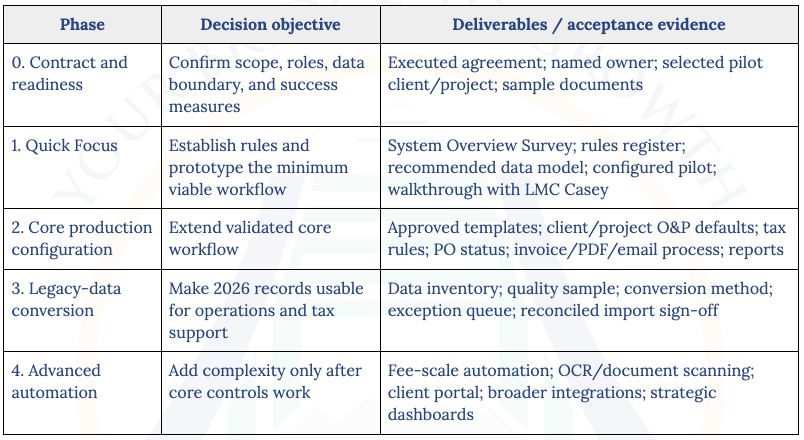
Right-size the solution path. LMC Casey had declined a $35,000, 4–6 month continuity sprint because it lacked liquid funds. Kaiban therefore introduced a phased option: an initial Quick Focus intended to validate configuration and reduce decision risk before broader build or data migration.
Orchestrate the market connection. Kaiban introduced LMC Casey to IdeaWeavers and framed CommonThread against the disclosed workflow, not against a generic feature checklist. The introduction identified the operational volume reported by LMC Casey: approximately 45 monthly invoices taking 10–45 minutes each to create, validate, and send.
Maintain implementation discipline. Kaiban advocated a pilot of one representative client/project, configuration of the simplest viable rules, and a separate plan for legacy 2026 data conversion. This preserves speed without treating historical-data migration as an undefined add-on.
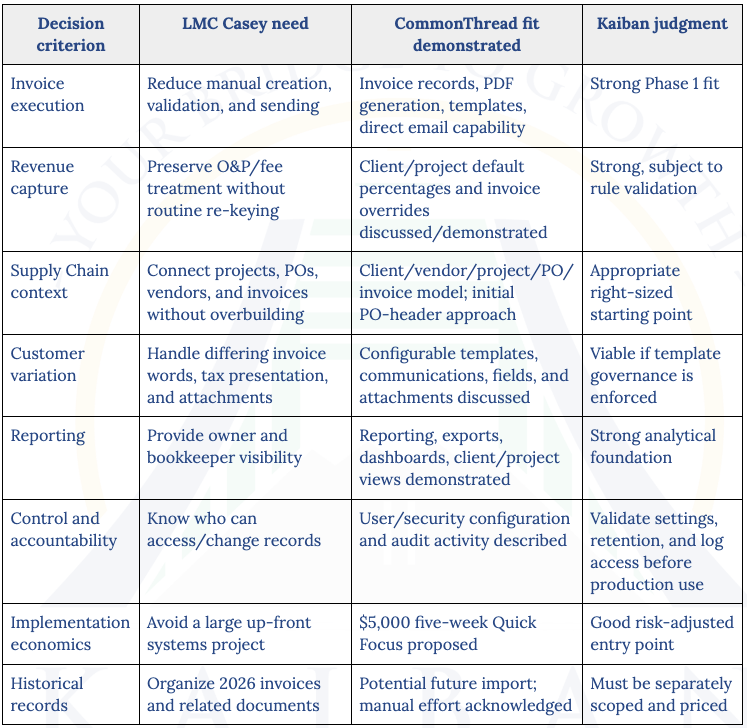
Why CommonThread Became the Preferred Solution
CommonThread was selected as the preferred solution based on demonstrations and the proposed Quick Focus process. During the demos, IdeaWeavers represented that CommonThread could support CRM, clients/vendors, projects, high-level PO tracking, invoice tracking, configurable templates, O&P-related fields, PDF generation, email delivery, attachments, reports/dashboards, customizable fields, user/security configuration, and audit logs.
The choice was driven by fit with LMC Casey’s operating model
Best-Practice Alignment
The recommended approach applies five practical controls commonly associated with successful finance-process automation:
Map and standardize before automating. AR automation requires assessing current workflows, standardizing invoice and dispute processes, and using workflow maps to express automation logic and business rules. Kaiban’s PO-to-invoice mapping and rules register follow this sequence.
Start with high-value, low-complexity work. Gain momentum by beginning with high-impact, easier-to-automate activities such as invoice generation before moving to more complex billing or dispute processes. The initial CommonThread scope prioritizes invoices, reporting, attachments, and PO headers before detailed PO generation, portals, OCR, and complex fee scales.
Harmonize master data and open-receivable definitions. Unified customer data, consolidated business-partner structures, and clear definitions of open receivables, payment terms, and due dates are central automation quick wins. The recommended client/vendor/project/PO/invoice data model supports that discipline.
Use a controlled pilot before expansion. Finance-automation guidance describes a progression from historical-data review through a pilot to wider deployment. Kaiban’s one-client/one-project prototype, followed by formal extension and legacy-data migration, operationalizes that practice.
Treat logs as a control, not a feature. Log management and security should be validated during configuration, including roles, retained events, access, and review responsibility.
Implementation Roadmap
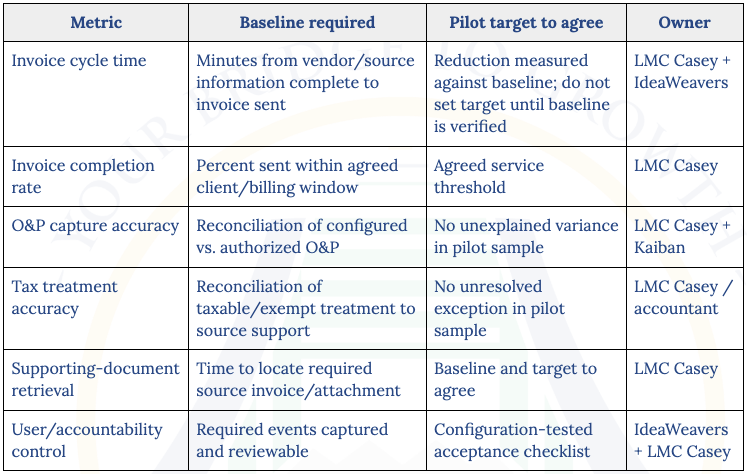
Success Scorecard
Value Created by Kaiban
The case illustrates a broader Kaiban proposition: Supply Chain and RevOps are not separate when a small, supply-driven business bills through complex customer, vendor, project, tax, and markup rules. A weak invoice process can obscure revenue rights; a poorly chosen system can formalize the wrong workflow. Kaiban’s initial value was making the commercial logic visible, creating a disciplined decision path, and connecting the client to a configuration-capable delivery partner.
After capturing sourcing and automation quick wins, Kaiban will help LMC Casey create the operating rhythms necessary to: 1) double EBITDA; 2) save 200+ founder hours annually; and 3) increase its enterprise value by ~50%.
For lean, supply-driven businesses, invoice automation is not a back-office software purchase. It is a revenue-control decision. The right implementation begins by mapping the commercial workflow, standardizing the rules that protect margin and customer trust, piloting the minimum viable process, and scaling only after the operating model proves itself.
