

Beyond Savings Theater: Rebuilding Procurement's Incentive Structure
Why partnership language upstream keeps colliding with savings theater downstream; and what it takes to fix the system, not just the story
For years, the profession has told a better story about itself...
Engage earlier. Challenge requirements. Align stakeholders. Treat suppliers as partners, not punching bags.
And stop measuring success only by the discount extracted after the real decisions were already made.
I agree with almost all of that. I have also watched well-run companies preach it in Q1 and abandon it in Q4; not because leaders are cynical, but because behavior follows the corporate (dis)incentive structure. Even procurement’s behavior.
The Uncomfortable Diagnosis
Traditional procurement incentives were built for a narrower job: receive a defined need, run a competitive event, negotiate unit price, report savings.
That design made sense when procurement’s main job was commercial hygiene at the end of the pipe. It becomes self-defeating when the organization asks procurement to influence specifications, capacity, continuity, cash, and risk before a supplier ever sees a bid.
In that world, a pure savings metric does three quiet forms of damage:
It rewards late intervention. The easiest “win” is still a price fight over a locked requirement.
It punishes good restraint. Walking away from a hollow discount that would break operations rarely shows up as a hero metric.
It teaches the business the wrong lesson. Stakeholders learn procurement’s value appears as a number on a tracker — so they invite procurement when they want a number, not when they want a better decision.
Partnership language upstream, savings theater downstream. That’s not hypocrisy; it’s misaligned architecture.
What Changing the Incentive Structure Actually Means
It does not mean “stop caring about cost.” Cost still matters. Boards and CFOs still care.
It means cost becomes one outcome among several, and the organization stops treating every non-price success as a soft story. A healthier scoreboard balances a small set of outcomes that finance, operations, and the commercial organization all recognize as legitimate.
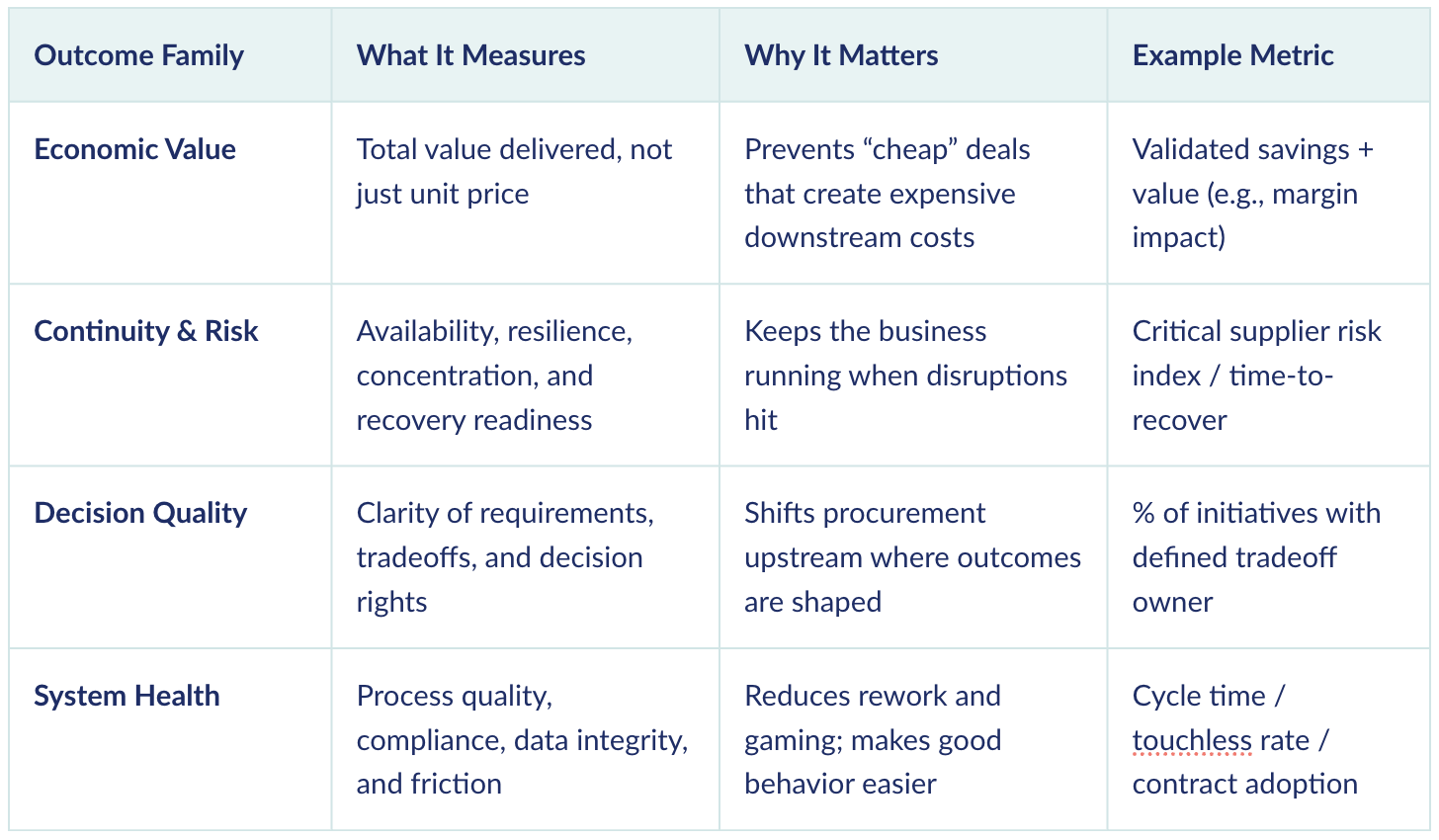
The point is not a 27-KPI dashboard. Complexity in measurement recreates gaming. The point is a short, shared scorecard that makes the “right” behavior the easiest behavior — especially at signature, renewal, and year-end.
The Multi-Year Journey
Changing incentives is not a memo. It’s an operating-model renovation.
Organizations that make it stick move through a predictable arc. Timelines vary, but skipping stages usually produces posters rather than behavior change.
Year 0–1: Make the Contradiction Visible
Ingredients
Executive admission that the scoreboard shapes behavior more than values statements
Baseline of where procurement is invited late, bypassed, or used only as the commercial closer
Honest inventory of what “savings” currently counts and what it ignores
One or two pilot categories to test a broader scorecard with willing business partners
Air cover from finance: permission to report a smaller savings number if decision quality improved
What good looks like: Leaders can say, without career damage, “We left a discount on the table because the requirement was wrong,” and that sentence is treated as competence rather than failure.
Year 1–2: Rebuild the Deal with the Business
Ingredients
Named tradeoff owners outside procurement for requirement changes that affect revenue, service, or launch risk
Joint intake criteria: when a request is “ready for market” vs. still a preference list
Shared metrics on a few categories (not enterprise-wide theater on day one)
Supplier segmentation that reflects business criticality and spend size
Manager routines that review decisions and closed events
What good looks like: Procurement is pulled into planning because it reduces the business’s chance of a bad surprise; not simply because policy requires a stamp.
Year 2–3: Hardwire Incentives and Talent
Ingredients
Compensation and promotion criteria that weight the broader scorecard, not only negotiated $
Role redesign: fewer pure transaction processors in strategic categories; clearer paths into supply chain leadership
Investment in data that supports total value and risk visibility, without waiting for a perfect platform
Supplier commercial models that reward availability, innovation, or recovery where the business needs those outcomes
Leadership reporting that shows continuity and decision quality beside cost
What good looks like: A high performer can get ahead without manufacturing year-end savings drama. A weak performer can’t hide behind a busy RFx calendar.
Year 3–5: Make It the Default Operating System
Ingredients
Enterprise adoption beyond pilot categories
Stable governance through leadership changes (the journey dies when the champion leaves unless the scoreboard remains)
Portfolio-level visibility of concentration, capacity, and dependency — especially after M&A
Continuous pruning of metrics that no longer change decisions
Orchestration habits that survive reorganizations
What good looks like: New executives inherit the system. They don’t need a charismatic leader to re-explain why partnership is not softness.
From Tactical Procurement to Strategic Supply Chain
A new scoreboard without new capability is cruelty. People will be measured on outcomes they were never trained or staffed to deliver.
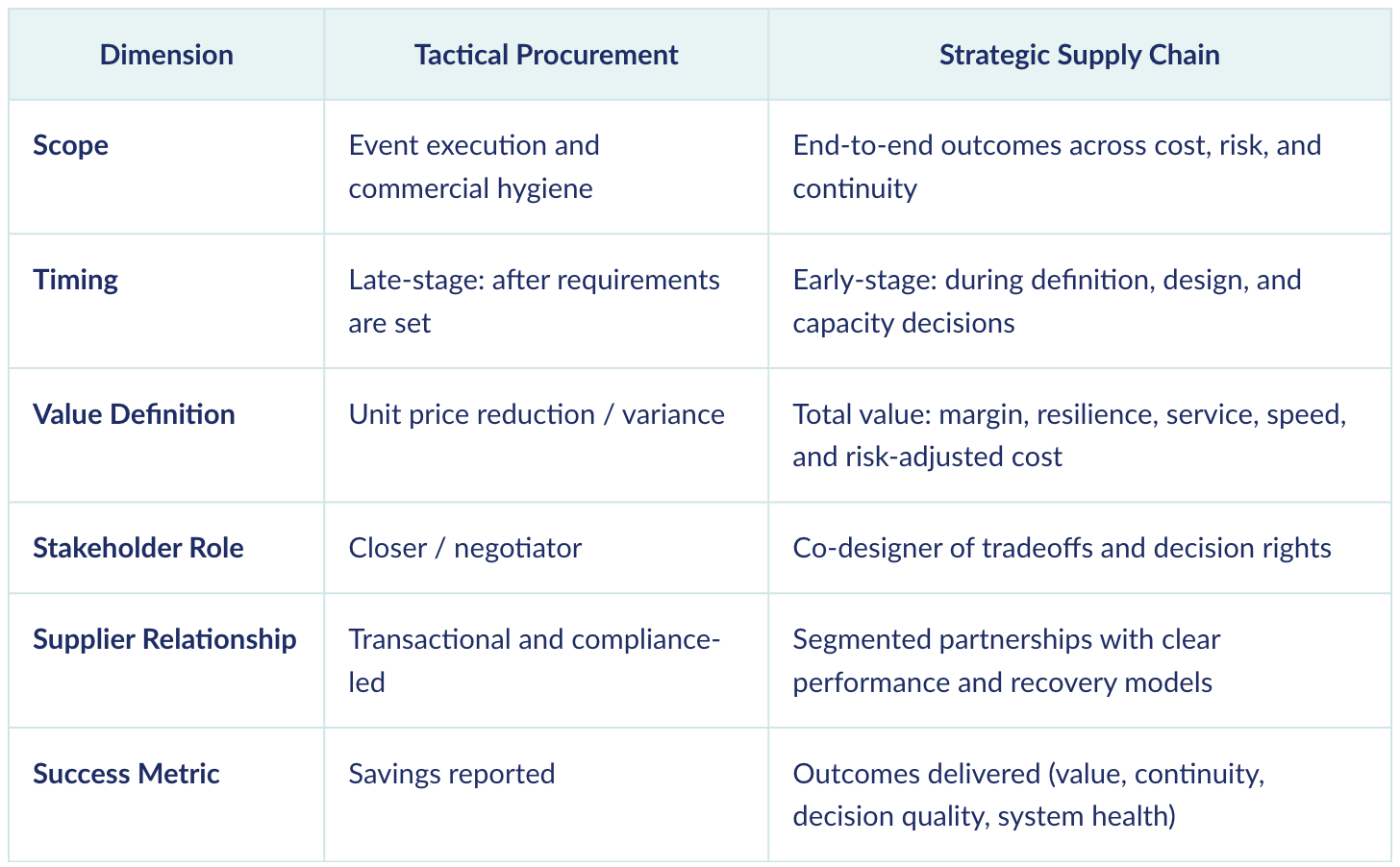
The shift is less about learning clever negotiation tricks and more about expanding the professional center of gravity — from end-of-pipe price capture to upstream decision shaping and system resilience.
Seven Non-Negotiable Competencies
Business literacy: how the P&L, customer promise, and operating constraints actually work in this company
Analytical judgment: separating noise from material drivers without hiding behind tools
Stakeholder craft: earning trust before attempting influence; knowing when to push and when to sequence
Systems thinking: inventory, service, quality, and supplier health as linked, not parallel
Commercial imagination: structures beyond “less per unit,” used only when they serve a real business outcome
Risk discernment: knowing when simplification helps and when optionality is the offer
Orchestration: the meta-skill that makes the rest usable at enterprise scale
The Power of Orchestration
Orchestration is not a slogan for “be collaborative.” It’s a capability: aligning timing, information, incentives, and decision rights across people who do not report to you.
In tactical procurement, success can be individual: “I closed the event; I got the reduction.” In strategic supply chain, success is both frequently coordinated and highly fragile (e.g., if even one party stays misaligned).
Orchestration matters because modern value doesn’t sit inside a single function’s authority line. Requirements are formed in one place, paid for in another, felt in a third, and recovered from in a fourth. If you can only optimize inside your silo, the cheapest quote keeps becoming the most expensive system choice.
Just as important: orchestration without decision rights becomes facilitation. Facilitation is useful, but it is not accountability. The journey has to clarify who can say no, who absorbs the political cost, and how success is shared. Otherwise, orchestration turns into endless alignment theater.
In strategic supply chain, the initiative works when the following align:
Engineering accepts a standard (or documents why it can’t)
Operations accepts a service tradeoff (and owns the impact)
Finance accepts a proof-of-value model beyond price variance
Supplier accepts a clearer demand signal and mutual performance model
Leadership assigns a named owner for the downside
What Leaders Should Stop Doing
Announcing “strategic procurement” while keeping a savings-only bonus plan
Demanding supplier innovation while running every interaction as win/lose extraction
Equating activity (events, auctions, reports) with progress
Assuming early invitation automatically equals influence
Treating consolidation and simplification as automatically smart without testing customer and concentration effects
Hiring for strategic competencies, then managing people with tactical dashboards
A Practical Test
Ask these three questions in your next leadership meeting:
If a buyer protects continuity and kills a bad requirement, how do they get paid and promoted for that?
If a stakeholder forces complexity into the supply base, do they i) share the downstream cost or ii) only capture the upstream convenience?
When procurement and the business disagree, is there a named tradeoff owner or only a longer email chain?
If the answers are weak, you don’t have a messaging problem. You have an incentive design problem.
Procurement's next era will not be won by better slogans about partnership.
It will be won by organizations willing to do the more intentional work: rebuild what gets measured, who gets rewarded, which competencies are staffed, and how decisions are orchestrated across the enterprise.
Early engagement matters. Supplier respect matters. Challenging requirements matters.
But behavior follows the (dis)incentive structure. Change that structure on purpose — over years, not quarters — or the old game will keep winning under a new vocabulary.
— Talon Rice, JD, MBA | An operator's view on procurement, supply chain, and enterprise decision-making
